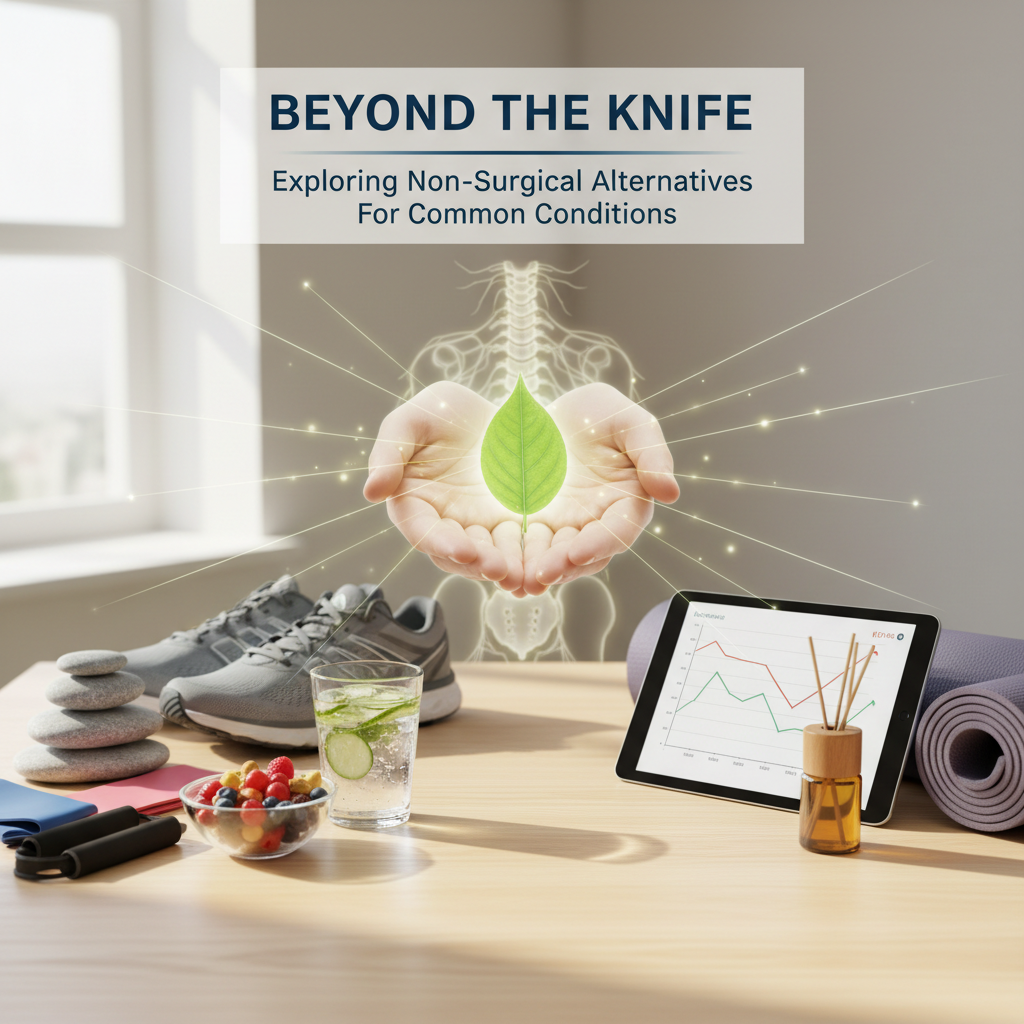
Beyond the Knife: Exploring Non-Surgical Alternatives for Common Conditions
This is for people who've been told "you need surgery" and are not ready to sign up yet — whether you're a busy parent, a weekend athlete, or someone nursing chronic joint or back pain. You're worried about risks, long recovery, lost income, and whether surgery will even fix the problem. Our clinic helps you explore proven non-surgical alternatives and build a step-by-step conservative treatment plan so you can try to avoid surgery safely, without guessing or wasting time. Learn more about Navigating Surgical Options.
What are the main non-surgical alternatives to surgery?
Short answer: there are several. Physical therapy, pain management, targeted injections, bracing, lifestyle changes, and emerging biologic treatments (like platelet-rich plasma) are the usual toolbox. Each has a role depending on the condition, severity, and your goals.
Here are the primary categories, with quick notes so you know what each does:
- Physical therapy - targeted exercises, manual therapy, movement retraining (best for restoring function, often first-line).
- Pain management - medications, nerve blocks, epidural or joint injections to control pain so rehab can work.
- Orthotics and bracing - offload joints, reduce nerve compression, improve alignment.
- Lifestyle changes - weight loss, activity modification, sleep and stress improvements (surprisingly powerful).
- Minimally invasive injections - corticosteroids, hyaluronic acid, platelet-rich plasma (PRP), sometimes local anesthetic nerve blocks. Learn more about minimally invasive options. Learn more about Minimally Invasive Surgery.
- Complementary approaches - acupuncture, TENS, osteopathic or chiropractic care (variable evidence, can help symptoms).
Can non-surgical alternatives help me avoid surgery for knee osteoarthritis?
Yes, often. But it depends on the damage level, symptoms, and how aggressive you want to be about conservative treatment.
Options to try first
- Structured physical therapy - quad and hip strengthening, balance work, and gait training. I've seen 12-week programs produce big changes; some patients report about 40% improvement in pain and function in 8-12 weeks.
- Weight loss and activity adjustment - losing 10 pounds reduces knee load by about 40 pounds when walking (real mechanics). So yes, lifestyle changes matter.
- Medications and topicals - NSAIDs, topical diclofenac, acetaminophen for flares (use as directed).
- Bracing and orthotics - offloads worn cartilage for certain patterns of arthritis (medial vs lateral compartment).
Injections and procedures
Corticosteroid injections give fast relief for many, but effects may last only a few weeks to a few months. Hyaluronic acid injections can help with lubrication and function for some people. PRP has growing evidence for symptom reduction in select patients (usually mild to moderate osteoarthritis).
Try conservative care for at least 8-12 weeks unless your pain is incapacitating. If you're improving, keep going. If you're not, escalate the plan (different sensors, second opinion, or consider surgery if quality of life is poor).
Can a herniated disc be treated without surgery?
Most can. I tell patients: 85 out of 100 people with a lumbar herniated disc will improve significantly with conservative care in 6-12 weeks. That's a lot.
Conservative options
- Physical therapy - directional preference exercises, core stabilization, nerve gliding (helps reduce radicular pain).
- Pain management - short courses of oral meds, neuropathic agents like gabapentin for nerve pain, and opioid-sparing strategies.
- Epidural steroid injections - reduce inflammation around the nerve root, sometimes enough to avoid surgery.
- Activity modification - temporary rest, then graded return to movement to prevent deconditioning.
You'll need urgent surgery if you develop progressive leg weakness, loss of bowel or bladder control, or severe, unrelenting pain that doesn't respond to aggressive conservative care. But most people won't get there.
What about rotator cuff tears - can I avoid surgery?
Short answer: sometimes. Look, full-thickness tears in younger athletes often need surgery. But many partial tears, and even some full tears in older, low-demand patients, respond well to conservative treatment.
Conservative pathways
- Physical therapy - scapular stabilization, rotator cuff strengthening, range-of-motion work. This fixes mechanics and reduces pain for many.
- Corticosteroid injections - short-term relief to enable participation in rehab.
- Activity modification - changing overhead activities, ergonomic fixes, and sleep position changes.
- PRP and biologics - mixed results, sometimes considered for partial tears when surgery is undesirable.
If you want to avoid surgery, commit to 3-6 months of consistent rehab, and reassess function. I often recommend imaging only after a solid trial of conservative care, unless there are red flags.
Are there non-surgical options for carpal tunnel syndrome?
Yes. Early to moderate carpal tunnel often responds well to conservative care, letting many people avoid or delay surgery.
Common conservative treatments
- Night wrist splints - simple, low-risk, often first-line.
- Corticosteroid injection - can give substantial symptom relief for months; useful if you need a predictable window of improvement.
- Ergonomic and activity changes - workstation setup, keyboard adjustments, paced breaks.
- Physical therapy and nerve gliding - some benefit, though evidence varies.
Electrodiagnostic testing helps decide if conservative care is reasonable. If there's severe axonal loss on testing, surgery is more likely recommended.
How do I choose which conservative treatment to try?
Good question. Choose based on three things: severity, goals, and time.
- Severity - significant neurologic deficits or severe structural collapse may need surgical review fast.
- Goals - do you need full return to high-level sport, or acceptable daily function? Your answer changes the plan.
- Time and commitment - physical therapy and lifestyle changes take effort but often pay off.
Practical roadmap: start with a targeted assessment by a clinician who understands conservative care. Then try a 6-12 week structured plan centered on physical therapy, pain control, and lifestyle changes. If you're not improving in that window, escalate to injections or advanced imaging. If still no relief and function is poor, discuss surgery with a specialist.
Which conservative treatments work best together?
Combo therapy usually beats single interventions. For example, pairing an injection that reduces inflammation with a 12-week PT program often produces better and faster outcomes than either alone. Why? Because the injection buys you pain-free time to rebuild strength and movement patterns.
- Injection + PT - often used for knee OA, rotator cuff pain, and radicular symptoms.
- Bracing + activity modification - useful for tendinopathy and early joint disease.
- Pain meds + behavioral therapy - addresses both nociception and pain perception (important in chronic pain).
What about PRP, stem cells, and other biologics?
There’s a lot of hype, and I get asked about these every week. PRP shows promise for certain tendinopathies and mild to moderate joint degeneration. Stem cell therapies are less proven and can be expensive. Here's the deal - some patients get noticeable relief, others don't. Research is evolving fast, so consider these after standard conservative measures, and make sure you understand cost, risks, and the current evidence.
How long should I try conservative treatment before considering surgery?
I usually recommend a minimum of 6-12 weeks for most conditions, and up to 6 months for degenerative issues like osteoarthritis, provided your symptoms aren't getting dramatically worse. Why? Because tissue remodeling and strength gains take time, and pain control needs a steady approach to let rehab work.

That said, urgent or progressive neurologic signs, or an acute severe injury that leaves you nonfunctional, are reasons to talk to a surgeon sooner rather than later.
How to measure progress while avoiding surgery
Track three objective things: pain score, function, and activity tolerance. Set clear functional goals like walking 1 mile, lifting your child, or returning to work. Reassess every 4-6 weeks and adjust the plan. If pain drops and function improves, keep going. If not, change tactics.
When is surgery the right choice?
Surgery becomes appropriate when conservative treatment fails to meet your goals, or when there's progressive neurologic loss or mechanical instability. Surgery isn't a failure - it's part of a spectrum of care and sometimes the right option to restore function faster. The key is making that decision with good data and realistic expectations.
What our clinic recommends (practical next steps)
If you're overwhelmed, here's a simple plan you can use today:
- Get a focused assessment (history, basic exam, and targeted imaging only if needed).
- Start a 6-12 week, goal-driven physical therapy program tailored to your condition.
- Use multimodal pain management (topical agents, short med course, and an injection if needed to enable rehab).
- Implement lifestyle changes - aim for 5% weight loss, sleep improvements, and activity pacing (small wins add up).
- Reassess function at 6 and 12 weeks; escalate to injections or referral if progress stalls.
If this feels overwhelming, our team can put together the assessment, a personalized conservative treatment plan, and clear follow-up milestones so you know if the plan is working. No pressure - just a practical path forward.
Common questions people ask
Can physical therapy really keep me from needing surgery?
Often, yes. For many conditions like early knee osteoarthritis, partial rotator cuff tears, and lumbar disc herniations, targeted PT can reduce pain and restore function enough to avoid surgery. That said, it's not magic, and it requires consistent effort.
Are injections safe, and will they delay necessary surgery?
Most injections are safe when done by experienced providers. They can temporarily reduce inflammation and pain so rehab can be effective. They shouldn't be used to simply delay surgery if surgery is clearly indicated, but they can be part of a sensible conservative plan.
How much do lifestyle changes matter?
More than people expect. Weight loss, smoking cessation, improved sleep, and stress reduction all change pain thresholds and healing capacity. For example, shedding 10 pounds reduces knee joint load dramatically. It's not sexy, but it's effective.
Are biologics like PRP worth it?
Depends. For some tendinopathies and early joint disease, PRP may help. For advanced degeneration or severe structural problems, it's less likely to be the solution. Discuss cost, evidence, and realistic outcomes with your provider before proceeding.
How do I know when to see a surgeon?
See a surgeon if you have progressive weakness, loss of bowel or bladder function, or if well-executed conservative care (6-12 weeks or longer where appropriate) fails to restore acceptable function and quality of life. Getting a surgical opinion doesn't mean you have to operate - it just gives you information.
If you want, we can walk through your specific case and outline 3 conservative options with pros, cons, and timelines so you can make an informed decision. Ready when you are.